
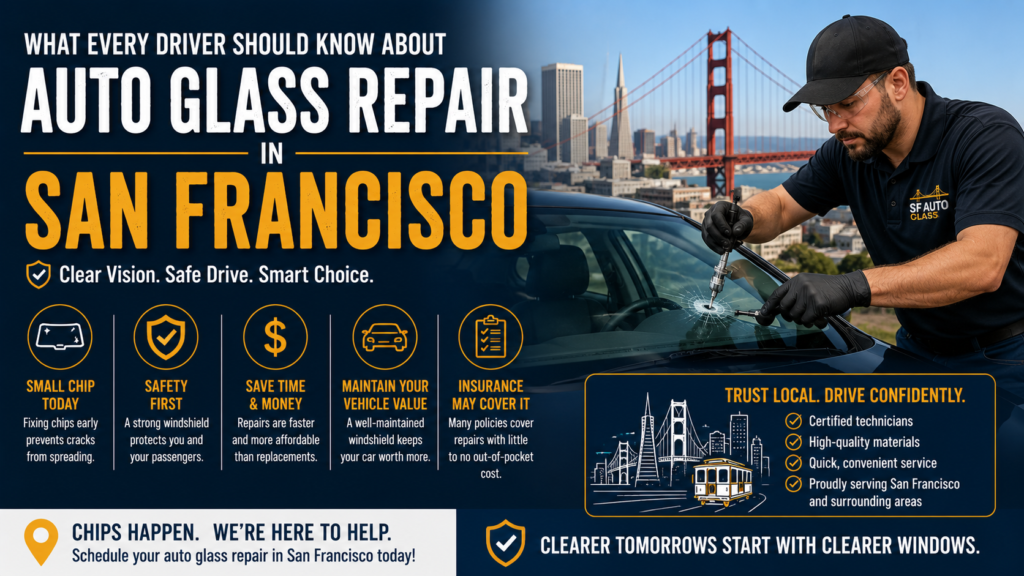
San Francisco is one of the most unique urban driving environments in the country. From the steep grades of Nob Hill to the congested Bay Bridge approach, from fog-shrouded ocean-view boulevards to the bustling Mission District streets, the city’s driving conditions are genuinely unlike anywhere else. For San Francisco vehicle owners, Auto Glass Shop San Francisco damage is an especially common issue and understanding the repair process can save time, money, and frustration.
Why San Francisco’s Environment Is Tough on Auto Glass
Several factors unique to San Francisco accelerate windshield wear and damage. The city’s famous fog creates persistent moisture that can seep into existing chips and cause them to crack further. Temperature inversions where inland areas are warm while the coast remains cold create thermal stress within the glass itself. Steep hills and rough pavement transmit vibrations that can worsen minor damage. And the city’s high vehicle density means more road debris and more chances for small rocks to become windshield hazards.
Common Auto Glass Issues in Urban San Francisco
While rock chips from highway driving are common everywhere, urban San Francisco brings its own set of glass damage scenarios. Vandalism and break-ins unfortunately not uncommon in some neighborhoods result in shattered door and side windows. Parking on inclines can cause unusual stress on glass seals over time. Exposure to salt air near the waterfront can degrade window seals, potentially leading to water infiltration and glass displacement.
The Difference Between Repair and Replacement
For San Francisco drivers assessing windshield damage, the key question is always: can this be repaired, or does it need replacement? The rule of thumb used by most professionals is that chips smaller than a dollar coin and cracks shorter than six inches (depending on location) can typically be repaired. Damage in the driver’s primary sightline, damage that has extended to the edge of the glass, or damage that has been exposed to moisture for a prolonged period generally requires full replacement. Getting a professional assessment quickly after noticing damage is always the best approach.
How Resin Repair Technology Works
Chip and crack repair using UV-curable resin is the standard professional technique. A technician drills a tiny relief point at the end of a crack (to prevent it from spreading further), then uses a specialized injector to push resin into the break under pressure. The resin fills the air voids, restoring optical clarity and structural strength. Once cured under UV light, the repaired area becomes nearly invisible and prevents future spreading. This process typically takes 20 to 45 minutes.
Windshield Replacement: The Full Process Explained
Full windshield replacement is a more involved process that requires proper technique to ensure safety. Technicians use specialized tools to cut away the old urethane adhesive and remove the damaged windshield without disturbing the vehicle’s paint or body. The bonding surface is thoroughly cleaned and primed. Fresh urethane adhesive is applied in a continuous bead, and the new windshield is carefully positioned with suction cups and alignment tools. The vehicle must then remain stationary for the adhesive to achieve proper bond strength before driving.
ADAS and Modern Windshield Technology in SF Vehicles
San Francisco’s tech-savvy population often drives newer vehicles loaded with advanced safety technology. Features like Tesla’s Autopilot, lane-keeping assist, and forward collision warning rely heavily on cameras and sensors embedded in or near the windshield. After any windshield replacement, these systems must be recalibrated by a qualified technician using specialized equipment. Failure to do so can result in inaccurate readings, false alerts, or more dangerously missed warnings during an actual hazard.
Glass Quality: Why It Matters for San Francisco Drivers
Not all replacement glass is equal. High-quality glass that matches OEM specifications ensures proper fit, optical clarity, and tint consistency. In San Francisco’s variable lighting conditions from bright afternoon fog glare to dark tunnel approaches having optically correct glass directly affects driver visibility. Substandard aftermarket glass may have distortions or fail to match the factory tint, which can be both visually irritating and potentially dangerous.
Mobile Auto Glass Service in San Francisco: Is It Feasible?
Given San Francisco’s parking scarcity and traffic challenges, mobile auto glass service where a technician comes to the vehicle’s location is especially practical. Many services operate throughout the city’s neighborhoods and can perform chip repairs and windshield replacements at homes, offices, or parking garages. The key requirement is that the vehicle needs to be parked on a level or near-level surface and remain stationary for the adhesive cure period after replacement.
Conclusion
Auto glass repair in San Francisco requires understanding the city’s unique environmental conditions, vehicle technology, and the practical challenges of urban car ownership. Whether dealing with a fog-induced crack expansion, a break-in shattered window, or a complex ADAS recalibration after windshield replacement, working with knowledgeable professionals is essential.